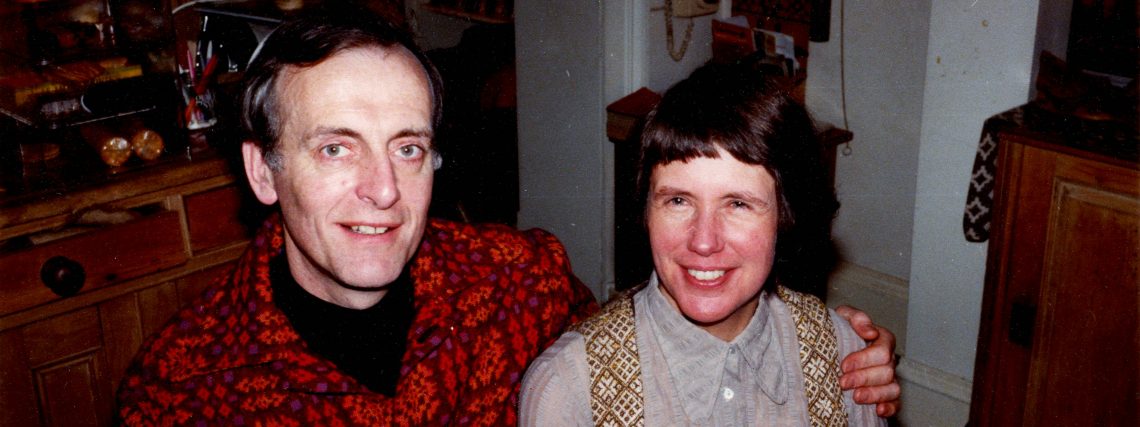
Anthony : Folding card tables have played a big part in my life. All to do with games, from being at Boghall, there were various ways of playing games, the most common of all was Father, who enjoyed at weekends playing patience – he got out a board and put it on his knee in front of the fire and he would sit quietly playing patience all evening, joining in the conversation but out of the five of us he was the quietest – he was a quiet individual. He carried on doing this right up until his death in my memory – I think he even had it in his old peoples’ home – it was a way of escaping others.
The next step up was in the dining room – we would unroll a bit of felt on the dining room table. Because it was a French polished mahogany table we weren’t allowed to scratch it and so we had this roll of felt which was cut to fit it, hence my habit of having this for our tables. My memory is of playing monopoly and tenpoloy (?), and Treasure Island – big board games – and we would all sit round the table with the board in the middle.
Then there was the playroom table at the very top of Bog Hall. I’m sure it would have been there when we had the evacuees after the Clydebank Blitz. They had the top floor of the house to themselves. They probably used it as a dining table. Evacuees. I remember it plainly – 1941 when I was six – one of my earliest childhood memories.
ANYWAY – back to the table, it was our ping pong table – a lovely table and the right size for it.
Then that table became father’s boardroom table at L Stern and Company limited, then I got it when he retired from Sterns, and then it laterley lived in number 9. It was first in the playroom and we used it for ping pong, and even put Barnaby’s railway board on top of it – it had many uses. Upstairs it was our dining table for a long time.
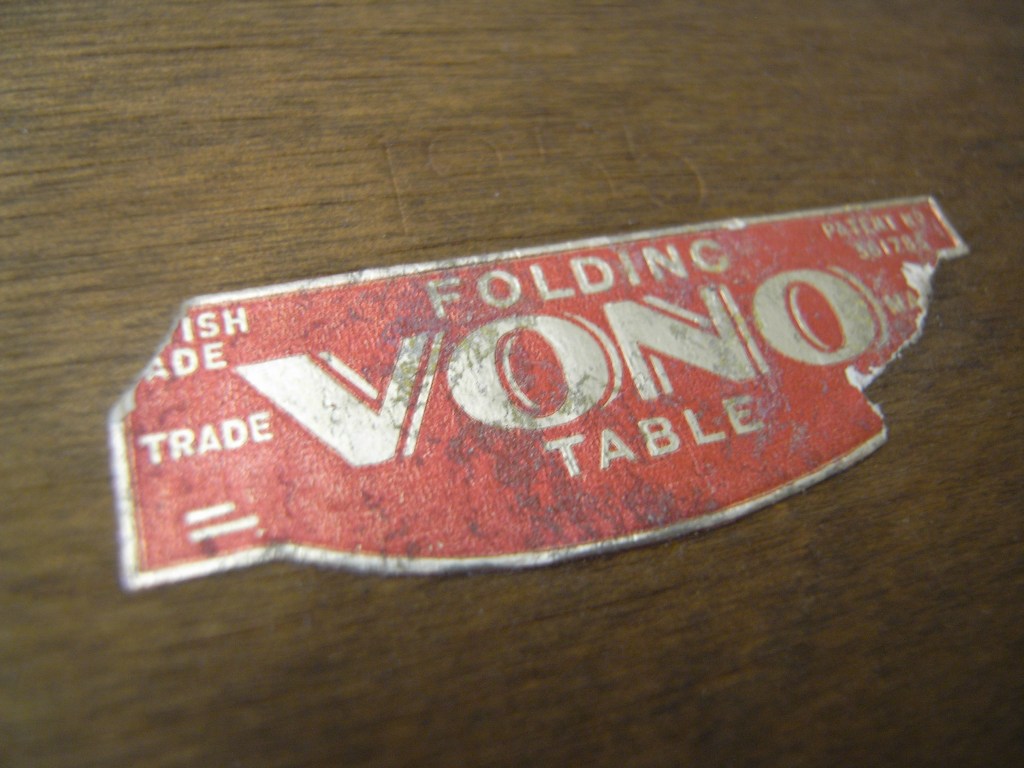
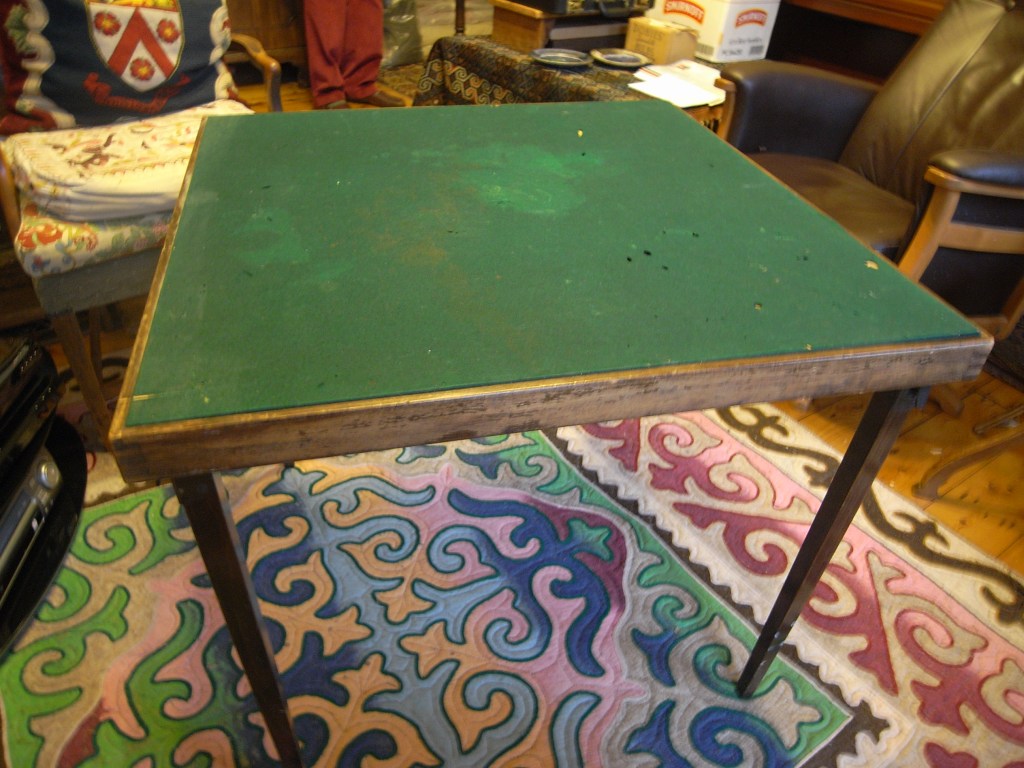
Then there were the card tables. Whenever one of the other tables were available, for example if mum was doing dressmaking she might take over the big table in the playroom for a week or even longer, she made all her own dresses and clothing in the war. So the card tables would come out – a standard VONO card table – standard 2’6 squared VONO table with legs at the corner which made it the right size. As children these were the standard tables we would get out. I’ve replaced the felt on them over the years. When we had Bovuy we needed tables for various projects, and so I bought 2 or 3 or 4 more. When we got the chicken huts for Paneurhythmy mum wanted tables so I got more.
We’ve used them through life, and now without using Bovuy we have too many of them.
You children used them for projects all the time. I usually had a tray for jigsaw puzzles so I could move it around, but didn’t typically use them for jigsaw puzzles. Mum played ordinary cards with us, like snap and whist, and we played bridge as children with mother and father, mother was a little impatient, not as impatient as Alison – she has a totally un-mathematical mind.
Ben was the one who enjoyed cards more than anyone, but we didn’t play a lot as a family. At one stage we had lots of specific games, card games, animal things – we had quite a collection. Quite apart from Happy Families of course, and memory games. They happened when I went to France for Star Refrigeration. You were all young at the time and I noticed Ravensburger which were high quality compared with anything you got in this country. Mum was a real supporter of Ravensburger, and whenever I was in France or Germany or anywhere, I thought it was educational and had to teach these children of mine. They were the single cards we used the most. [Now] I will put a table out for putting out mum’s packing, because every flat surface is covered.
[back to the evacuated family staying at Bog Hall – how did that happen, did everyone with a large house get asked to take people in?]
It was an enormous emergency and these people had to be housed, but if someone got in touch or we got in touch I have no idea. I have no memory of a man, a father, I suspect because we were rather remote, and probably it was just the mothers and children came and stayed. I don’t know how many people we had, but I reckon about three families with an average of two or 3 children each, I don’t know. It was such a class conscious situation that the parents, or my mother, tried to keep us separate. Awful to think of it now, but we didn’t mix, but latterly at Sterns when I was doing my apprenticeship someone remembered me – he was one of the evacuees. He lived in Maryhill where Sterns was – he was a boxer, and became Glasgow lightweight champion, and he would always come up to me and we would have a chat. Neither of us really remembered the Clydebank days but he remembered it as a nice period of his life in a traumatic situation. I reckon they were with us about a month, but I don’t know. They tried to get everyone back to the area to keep everyone together.
I think I mentioned father in the home guard making tank mines and we would make them in the front room and he would go out and put them in the road when invasion was threatened.
We had all the lights in the Campsie hills that lit up hoping to divert the German planes but the River Clyde was so obvious from the sky even at night so they were never going to think these lights in the hills were Clydebank.
One had to volunteer for the home guard, but there certainly would have been strong pressure put on anyone not fit for military service. My father was excluded because of the importance of refrigeration on ships for importing food. Mum’s father was an air raid warden – everyone did something. He had a khaki uniform – for children it was very exciting. And sometimes when the home guard met at our house when going out on patrol or coming back from patrol it was very exciting. Father’s Great Coat I eventually got, Mother died it navy blue and it was my standard overcoat when we had to watch matches when it was so cold [at the boys’ boarding school].

 The Royal Collection