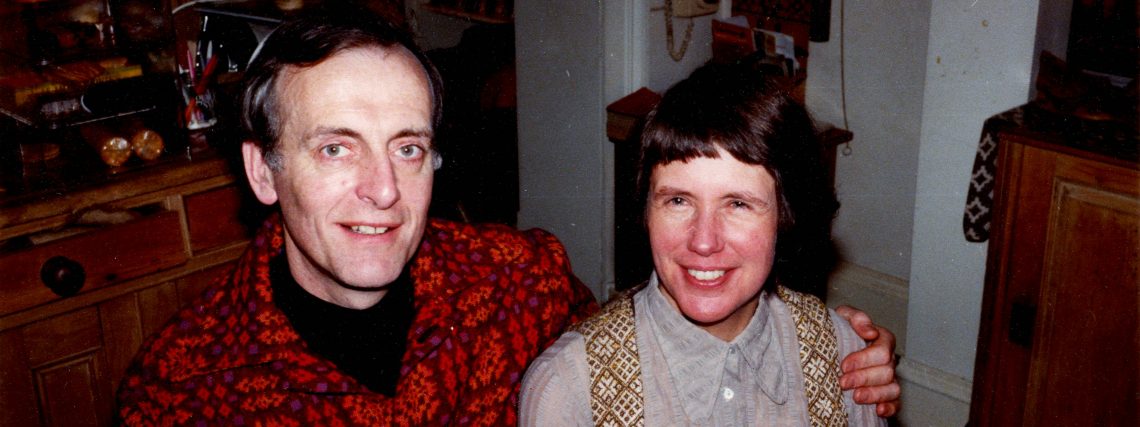
Alison : I’m holding in my hand quite an aged postcard entitled Brindisi 11th April 1965 and it is a a very friendly postcard indeed from George to me, Alison Roberts, garden flat, 35 Ladbroke Grove
[where she was living with Jackie]
It’s quite fun, just for interest, because he is a known character to you
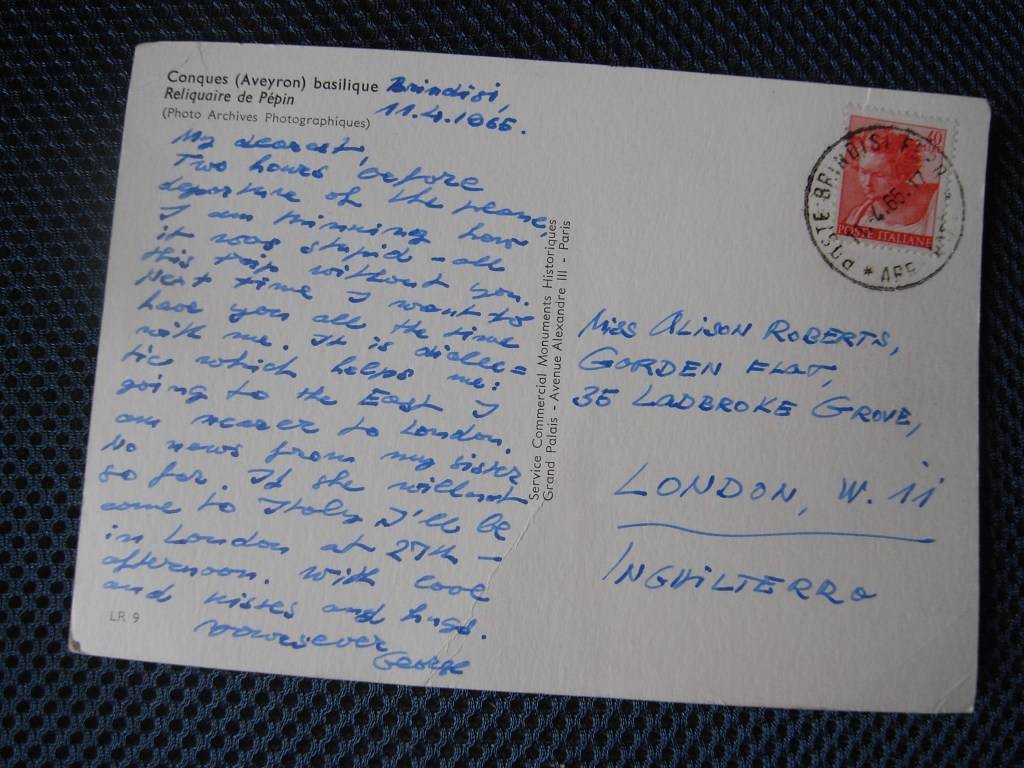
‘My dearest, two hours before departure of the plane, I am thinking how it was stupid, all this trip without you. Next time I want to have you all the time with me. It is dialectics which helps me. Going to the East I am nearer to London. No news from my sister so far etc etc Love and kisses and hugs, George’
[Mil – so what stage was your relationship at?]
Anthony – I assumed they married in 1966 because you were born in Feb 1967
Alison – it might have been May – I can’t even remember where I was married to George – I don’t remember at all.
[Mil – how long between meeting and getting engaged?]
It was relatively quick that we got engaged. I think that was a bit of a mistake on George’s part. I remember in the garden flat George saying something flippant and I said ‘why not – let’s get married’ and there was a very long silence while he was digesting his potential mistake remark. He was a great guy though, great guy. He was very fascinating and attractive. He was I think an assistant art history lecturer somewhere. [this link shows George’s work history and state he was senior research fellow at Warburg Institute in London in 1965 and 1965]
It was posted from Brindisi which is Greece, isn’t it? Antony – Brindisi is south of Italy.
[Mil – the postcard is French]
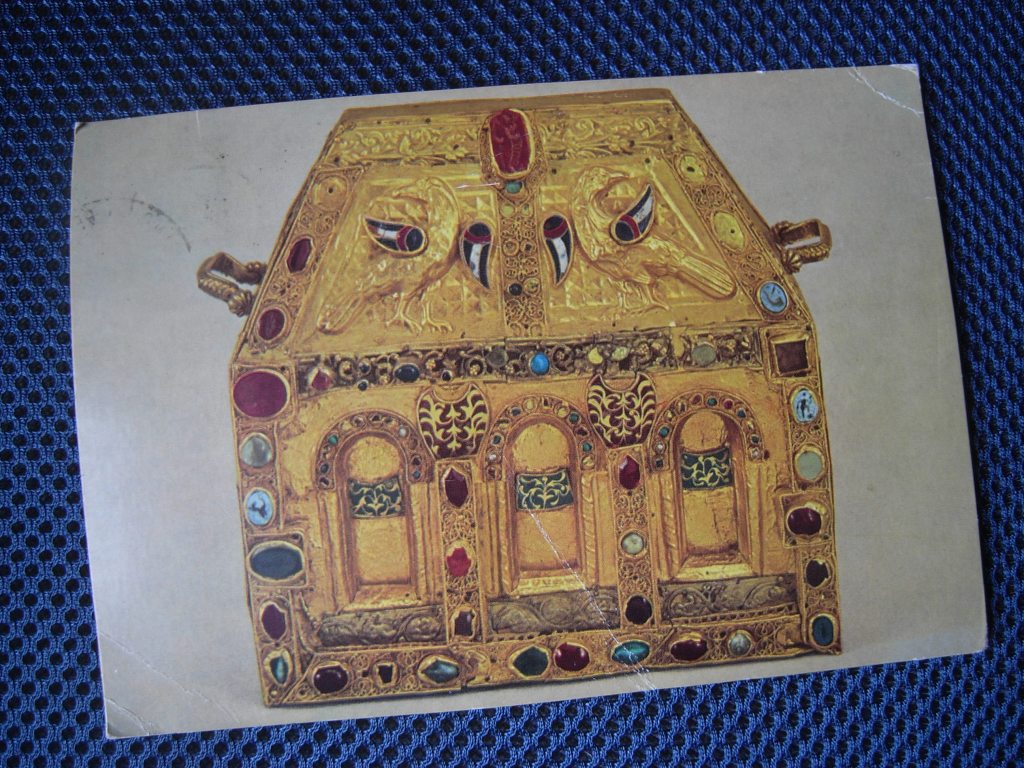
The subject of the postcard is Merovingian and I was right into the Middle Ages art which is how we met. As far as I remember he was an expert on early Christian alter tables, so he was right into this kind of stuff, and so was I. It’s a very beautiful Merovingian casket. It’s a rare thing. It’s from where Pepin’s ashes were from.
[Mil – did you ever go on a trip with him?]
Alison – I don’t think I did really. Oh yes, he did take me to meet his mother, for approval.
Anthony – my memory of what you told me is that you went for your honeymoon out there, and you met his previous children, one or two – did he have a daughter than you didn’t know about?
[Mil – we only became aware of that after he died, and Mum didn’t know that, and the daughter declined a DNA test]
[Mil – how did you meet George?]
There was an old gentleman who was an art historian and I went to have supper with him in Chelsea, I think this gentleman’s name was Eustace Remnant, and George Stricevic was the other guest there.
[Mil – that would have been 1964 what were you up to at that point?]
I think I would have been at the Courtauld Institute.
[Mil – between leaving Cambridge and then, did you ever have a job?}
No not really, but I was doing my silversmithing work in Sylvia Makower‘s house. I did a sort of an apprenticeship with someone called Claude Geoffroy-Dechaume. That was before Cambridge I think, because then I had an awful decision to make because I got a late acceptance to Girton when I had rejected that. I was going to be a Silversmith, then I got this prestigious chance, and I remember my mother was rather keen, but I always regret it though because I became an academic but I always thought of myself as an artist. I started an MA at the Courtauld Institute. I can tell you what the subject matter was. It was a delicious gospel book from 740 AD, really old and it was called the Gospel Book of Chad and it was in Durham Cathedral library and I remember a peculiar episode when I went and studied this book in detail and because of high security one had to be locked in, where the precious books were, and then the librarian went out for lunch, and unfortunately forgot about me, and I had a very distressing time. An intimate collusion with this Book of Chad. Longer than I had perhaps desired. And it was a very very long time before this man came back.
It was a 2 year MA, and I didn’t finish it because…. Was it something to do with meeting George Stricevic?
Anthony – clearly your time with Syliva Makower was after university – was it in her basement?
I remember the long long walk, tramping along the road to Sylvia’s house. She was a great comforter in my youth, this lady. Sylvia Makower was a very very lovely friend of my mothers. She came from a distinguished aristocratic family called Chetwynd. But she herself met mother I think at Cambridge, and she had a lovely funny crazy husband called Anthony Makower who was wonderful with children and he actually took notice of me. I know that my father won both their affections because my father first purchased some paintings he did, my father was great at encouraging aspiring artists – that was my dad’s great quality. She wasn’t a silversmith, She was a musician actually, she played the viola, I made music with her. [Mil – why did you have a studio with her?] – because I wanted to get out of my parents’ house. She gave me room in her basement for my silversmithing. She was an extremely intelligent and nice woman, and we are still in vague touch with her son Michael who lives up here in Stirling.
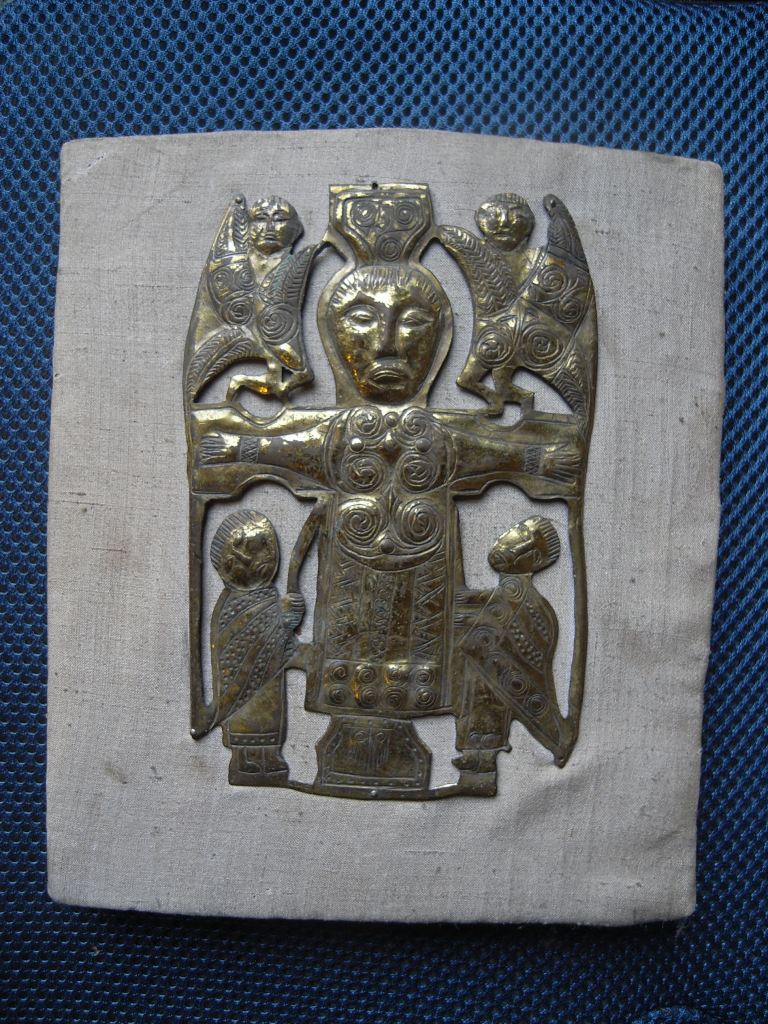
[on silversmithing] The very first piece I did was in brass and it was a crucifixion plaque actually, it was nice, a copy of an 8th century piece. Later on I did sell stuff, particularly christening spoons.
I was very partial to insular art, our own art, and that’s an 8th century piece, copy of…
I think it is from the Litchfield Gospel book, but I’m not sure. It was an altarpiece. I don’t know why I chose to do that, but I was always rather smitten by religious art.
[Mil asks what Alison’s family thought of George]. Father was always very nice, but the one person venomously against it was my nanny. My nanny was an astute lady and she loved me dearly, and my brother too. [Anthony says- and there was no-one more persuasive of my friendship with Alison than nanny.] I remember her frigid disapproval, Mil. [Mil asks why on earth there was still a nanny on the scene]. She stayed on with us you see long after she was needed. I think she just lived with us. We had a lovely woman called Mary who was the cook and housekeeper. But nanny was a great friend of Mary. The only thing I really remember about Mary was that she was a devout Catholic.

 The Royal Collection