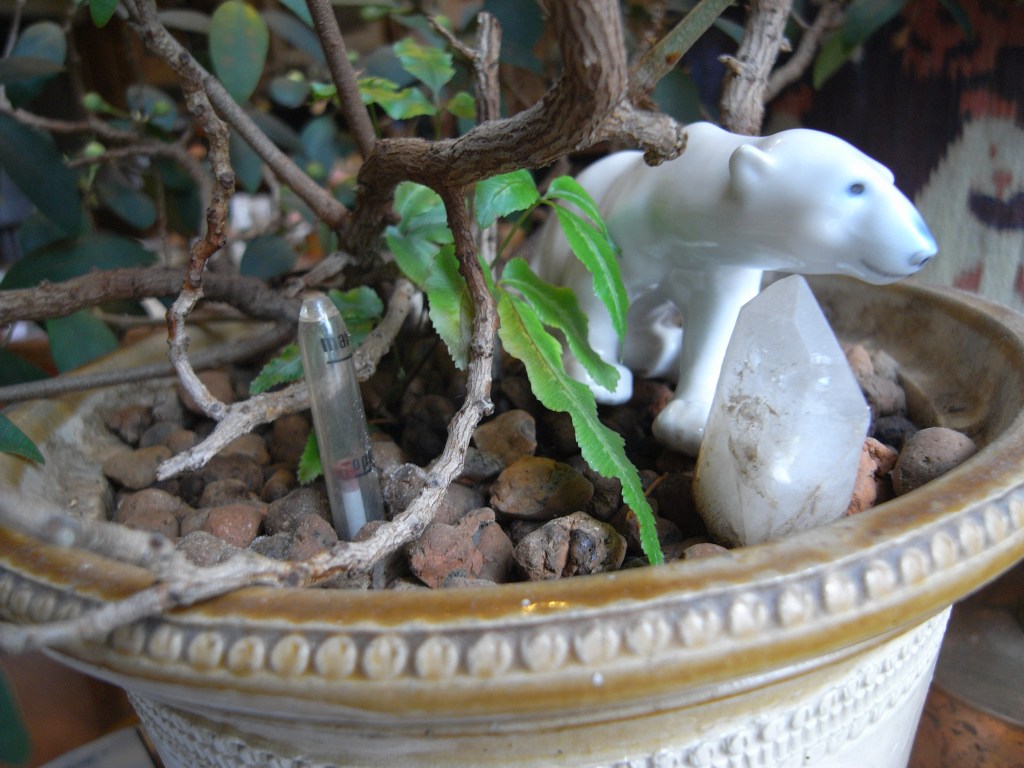
Anthony : The polar bear is just a folly. It’s the mascot or trademark of a Danish company called SABRO so it’s all to do with work and Star Refrigeration or refrigeration in general. Nothing to do with family and life etc except that one has the fall out of course that my work life is very much to do with family and family with work life etc. It must have been when I first finished my apprenticeship at L Stern and Co so that was in 19….. 58-60, when I moved into the office one of the first things I was responsible for – I was in the technical sales department one might call it – where my job was to learn to estimate, ie to price things, and write quotations to get orders because in then we didn’t have a single product as such, we were selling plant to achieve an end, and so having learned that a customer wanted to achieve something, whether it was to build an ice rink or a cold store, or to develop whatever refrigerating process he had, it was our job to research, which is a grand word – to work out what was needed and to develop a scheme to achieve this. And at that stage almost all the ice manufactured in the world was manufactured in ice cans which were great big galvanised buckets weighing, oh they could be small, just ah…. A hundred weight or so but the typical ones were two hundred weight and bigger and one filled the cans with water, there were great rows of them in harnesses and lifted by crane with special water filling devices – if there were 20 cans, 20 pipes would come down and fill them. They were big bits of equipment and it would sit in a bath, or a tank full of brine and it would be the brine which was refrigerated and it would be the bine that was circulated in the tank so the galvanised cans of water would freeze and after a period probably a day, two days, they would be frozen, and the great benefit of that apart from taking space was that it included storage, if nobody wanted to buy the ice then it just lay in the cans in the brine tanks and since the brine was cooled by a refrigeration tank controlled by thermostat it just ran very little when not in demand but usually they were designed so one emptied the tank at each cycle whether once a day or once every two days. Because it took that sort of time for the water to freeze and that was a typical plant. We exported these from Stern – these were our major export work to Iraq and Iran these were our major markets but included the whole of the Middle East, we had plants from Cyprus down the Egypt and Jordan and even Saudi Arabia but the main were Iran and Iraq really because from political terms that was where Britain had influence. No doubt Syria had as big a demand but that would have been supplied by French companies because that was how the politics lay. And as an apprentice I was asked to investigate new forms of ice making which other companies had developed and one of these was a company called SABRO, a Danish company, and really refrigeration in Europe was led by Denmark and Britain, whether because of export markets or whatever, I can’t know. But Scandinavia were ahead of us in many things but in particular meat cooling – the Danish bacon industry were the world leaders in pork and cured pork and refrigeration because they were so dependent on it, and so my job was to try and introduce some of these new methods of ice making into Britain, of which the most popular, or which seemed to have the biggest benefit, was flake ice. And flake ice was made by spraying water on a cold cylinder and as it, the thickness of the spray, and so the skin of ice was very small, and as the cylinder rotated, so on each cycle the cutter cut what was a newly formed ice and it dropped down as flakes of ice, and there were various devices, but Sabro of Denmark from R Haus??? was …they and Stows, the other big Danish company, Stow was Swedish, they were the leaders in flake ice, Stow made tube ice and they were all ahead of us. It was a state of Britain industry after the war. We were relying on the past and not developing for the future. There didn’t seem to be economic pressure to develop new things. All the British refrigeration companies were all in the same boat. And so I worked a lot on this and so I got to know the Sabro company because as a customer, and I visited Sabro on a number of occasions , and this continued for oh I should think 30 years – middle 60s up to middle 90s, and on one occasion they gave me that polar bear and I have always kept it in that plant which I’ve had for over 30 years now. It’s a very slow growing member of the fig family. At Star Refrigeration it was on my windowsill and that’s where the polar bear first joined it. It’s of no value at all.
[Mil asks if they were happy for him to be doing industrial espionage]
Oh no we bought their flake ice machines…. We were selling plant. And one of the companies, the French companies that made flake ice machines were based at Nantes and they were less honourable than us. They stole the Sabroe designs and built their own flake ice machines. We did try and make a tube ice plant. We made one or two and sold them to Ciba-Geigy in Paisley which were in a sense copies of the Stow of Sweden but there were problems with the Stow plant and they wouldn’t do it the way we wanted so we made it ourselves and anyway that got me really launched in L Stern and company because I was the first person who actually put information, well the first person was my father, to put together information to enable other engineers who were less able to learn about the process and sell the plant we wanted to sell and I set up a system of information and tables, rather I imagine as today one would have an app, for designing flake ice plants. So that’s really the story.
We never developed a flake ice machine as I said we developed a tube ice machine and various ice making machines none of were particularly successful. In my father’s last days he helped Peter Spinney design old block ice machines (made in galvanised buckets) which Peter had a lingering market in the Middle East. Peter was the son of a Spinney who had major business in Cyprus and so they had a very good market all round the Middle East and so he had some old fashioned customers continued to want to make block ice.
[Mil asks if he thinks the refrigeration industry has had a big impact on the environment]
Oh yes it does. I mean the refrigeration in its broadest sense consumes between ten and twenty per cent of all electricity and its a major contributor to greenhouse gasses. One reason of Star’s success is that we have developed much more efficient methods of refrigeration than were previously available. We always did that with energy in mind, but we didn’t sell them as such and so often it was feedback from customers, customers would say after they’d been running our plant for a year or two, “we like Star Refrigeration because it only costs half as much to run” which means it consumed less electricity which means it was more efficient. And we kept a large part of our clientele because those who had our plant realised this. Those who didn’t have our plant didn’t believe us when we told them this. One is always very suspicious of salesmen, but one should attempt, one should listen and attempt to evaluate what is being said. One reason we were so successful is I spent a lot of time in preparing quotations to give potential customers information and it did win lots of orders.
The polar bear represents ice and in the early days of refrigeration ice was by far the biggest product. Ice making was used for food preservation. Several of the National Trust houses in Scotland and lots in England have ice houses which was where ice was stored. Ice would be cut from glaciers in the north and imported into Britain and distributed and kept in ice houses where it would keep for up to 12 months.

 The Royal Collection